
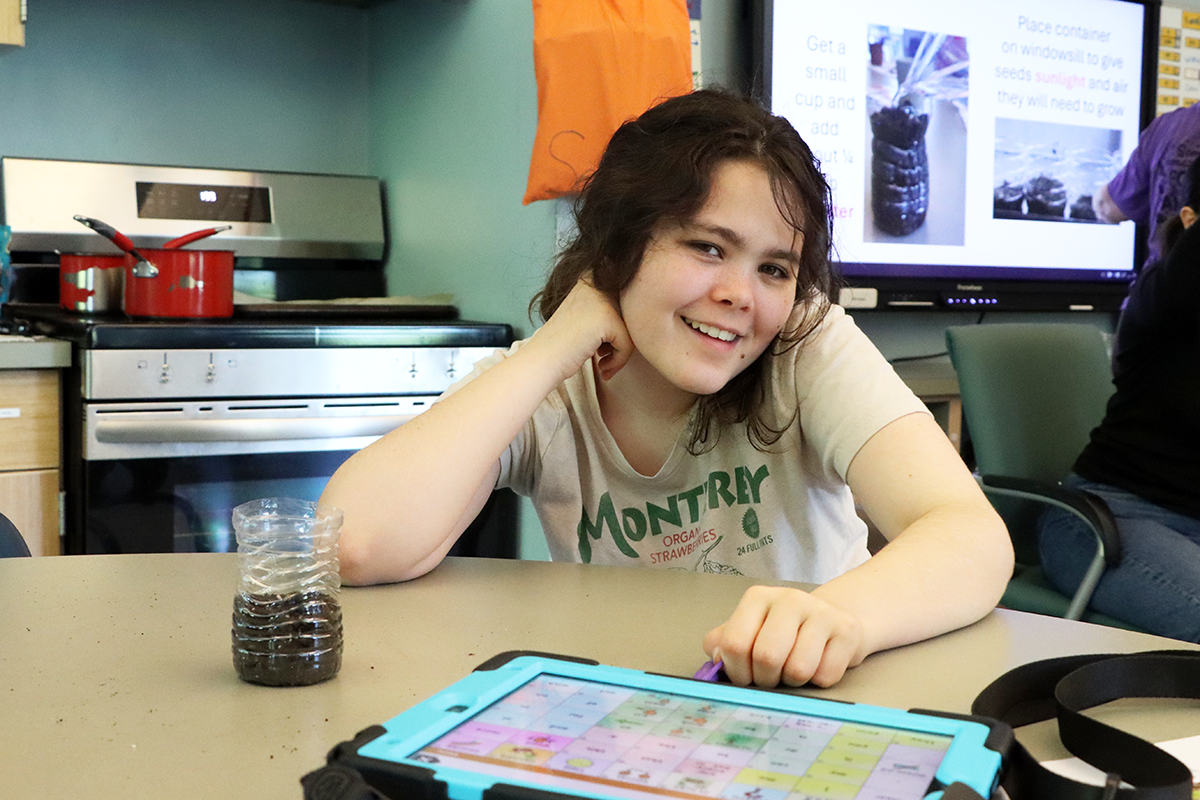
On a sunny afternoon in the Transition Classroom, students come together to write a story.
Students take turns selecting illustrated cards that Lead Teacher Arielle Debira has spread across the table. Each student says something about their chosen card, and Arielle writes their sentence on the board. Students are excited and motivated when they see their ideas included in the story.
One classmate, Sawyer, types out each sentence on his iPad. Once every student has used their card, Sawyer uses his device to read the entire tale to the class. Gus gives the piece a title, “Sky Full of Stars,” which perfectly encapsulates what it means to be part of the Transition classroom. Everyone’s ideas matter; together, their ideas reflect both themselves as individuals and the classroom community they build.
These group activities, called Unit Group, are just one way that Arielle is getting students to work collaboratively and feel excited about learning. Each student’s daily schedule looks different based on their individual IEP goals. Some students focus on academic skills, while their classmates spend part of their day at work. All of which makes coming together even more important.
“For them, being together doesn’t need to look any one way; they benefit, as all children do, from negotiating social interactions, participating in greetings, including one another, and even from sharing materials,” said Arielle. “They’re smart, they’re capable, and they have a lot to say.”
To begin Unit Group, Arielle will model a different type of greeting that incorporates both social and academic skills, such as greeting with a handshake after finding a partner with a matching uppercase letter card to their lowercase letter card. Once the main activity begins, students spend the rest of their class time sharing materials, reading together, and communicating with their classmates using their voice or their augmentative device.
They do this while gaining exposure to both social studies and science topics. Students spent the fall in a social studies unit called Staying Safe. This covered different safety guidelines around emergencies, fire, water, sun exposure, traffic signs, and more. Students demonstrated safety skills and awareness in the community, whether on field trips or weekly trips to the grocery store.
This winter, students embarked on an SEL (social emotional learning) unit about making friends. They learned about activities to do with friends, how to find friends, and how to tell if someone is friendly. They even participated in “interest clubs” such as the building and walking clubs.
In the spring, students enjoyed a science unit about living things. They talked about ways to tell if something is a living or non-living thing. They hatched sea monkeys and sprouted seeds, sorted garden cards, played games, and even wrote a book together about living and non-living things they chose around the school. Kristina wrote a page about the garbage can and took a photo to go with her text, while Adriano chose to photograph and write about a bumblebee.
By weaving together content, social emotional learning, and literacy skills, Arielle is able to meet the needs of students with a variety of needs and abilities. “It’s about exposure to content that is also functional for them,” said Arielle.
Building students’ self-confidence is perhaps the biggest benefit of Unit Group. “We’re all participating together. When someone sounds out a tough word, we clap for them, and that puts a smile on every face. They have opportunities to read, write, and share in front of peers that they wouldn’t otherwise, and they get that recognition that feels good no matter what skills the learner has and is working on. My biggest goal for them is to have confidence and take pride in their work.”
The students of the Transition Classroom have plenty of reasons to be proud of themselves. Stanley has started a new job at the Windsor Athletic Club, assisting with all types of cleaning. Gus was selected as an Honorable Mention Winner of the New Jersey Association of Special Education Partner Schools (NJASEPS) Art Contest. Emma does clerical work at the Plainsboro Municipal Building.
Adriano sets up tables and chairs in the morning at Romeo’s Restaurant. Sawyer learned how to use an AI pen to help him read anything he likes. Sarah is also learning to use the AI pen and has excelled at expressing her wants and needs on her Augmentative and Alternative Communication (AAC) device. Kristina has worked hard to build vocational, domestic, and self-help skills while also strengthening functional academic skills such as counting and following written directions.
Next year, Adriano and Stanley will move up to new classrooms, taking with them the knowledge they learned and the self-confidence they acquired in Transition. The Transition team will miss them but can’t wait to hear about the wonderful work they’ll do in High School 2.