
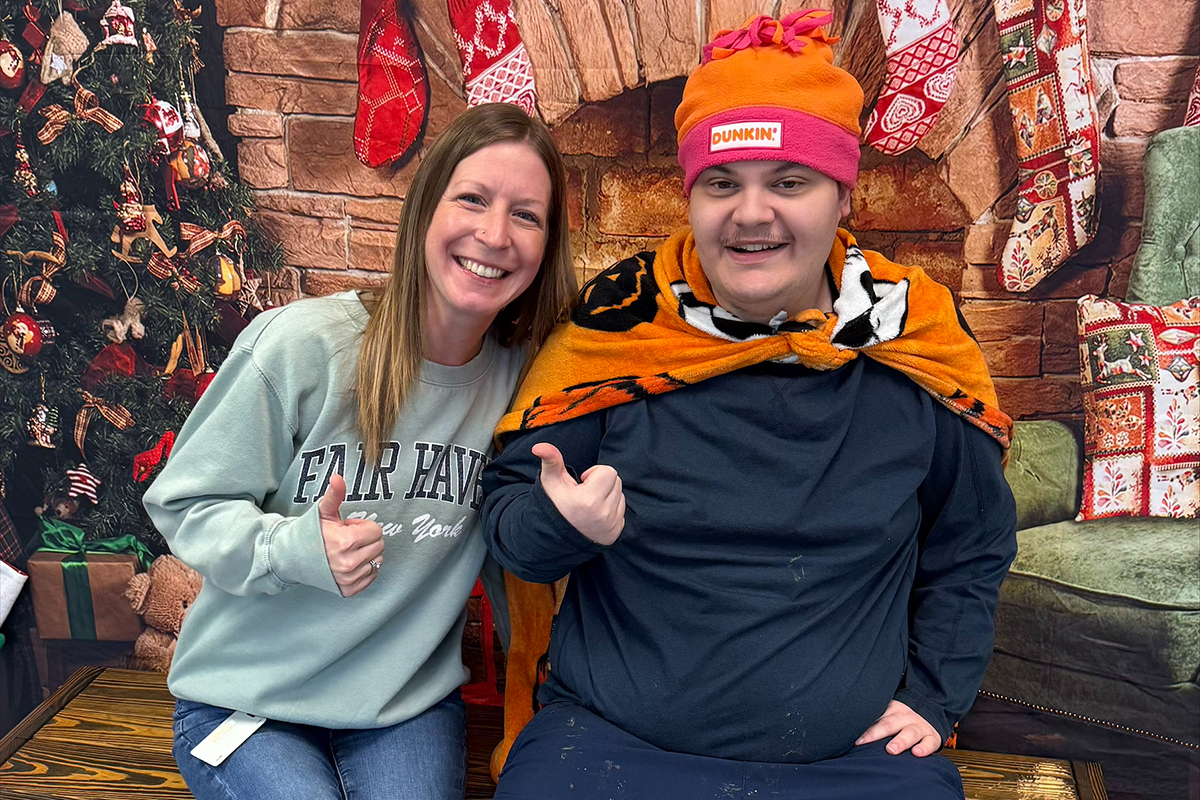
Lead Speech Language Specialist Margaret Steinruck is a second-generation Eden employee. Her mom was a teacher in the middle classroom back when the school was located on Eden Way.

“She would do a lot of respite after work. She’d have a lot of students staying overnight at our house, and oftentimes I remember giving up my bed for the student, and I’d take to the couch,” said Margaret. “I just really appreciated everything that my mom did working with the population, and I saw that a lot of the students that she was working with were nonverbal, and that’s when I knew I wanted to be a Speech Language Pathologist and work on giving these children and adults ways to communicate effectively.”
Margaret has worked at Eden since 2009. She primarily works with the adults Eden supports. Often, she is the first person to introduce older adults to technology that wasn’t readily available or didn’t exist the last time they had speech services. “It’s really rewarding to be the first person to provide older participants with speech lessons for the first time in many years,” she said.
Helping older participants learn how to use technology to communicate has become a highlight of Margaret’s job. One adult with an iPad has begun to spontaneously tell people that he likes walking on the boardwalk with his parents and listening to Bob Marley. Another individual tells people about his dad, and can now tell people where he wants to go. Those little moments are the most rewarding.
“It’s great to see them be able to self-advocate, initiate conversation, and make their wants and needs known,” said Margaret
While technology has opened up new ways for individuals to communicate, Margaret works with a variety of modalities — gestures, sign language, Picture Exchange Communication System [PECS], iPads, and other Augmentative and Alternative Communication [AAC] Systems. The goal is to ensure all individuals can communicate effectively, not just with Eden staff but across all settings with a variety of people.
“It’s rewarding as a therapist to see the gains that the adults make and to know that you helped them along that journey,” said Margaret. “Being able to see them expand their expressive, receptive, and pragmatic language skills, and being able to generalize those skills so they’re not just able to demonstrate skills in a speech session, but able to generalize those skills with people in the community and at home, brings a smile to my face.”