

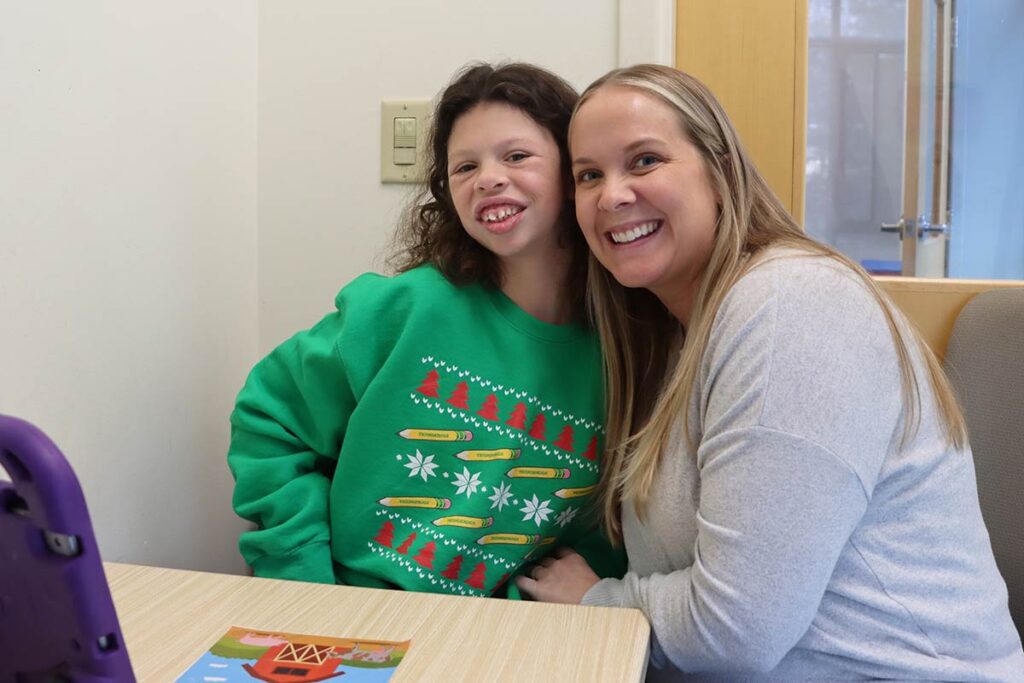
Abby Tappert believes you’re never too old to improve your communication skills. As Lead Speech Therapist, she sees autistic children and adults use a variety of methods to communicate.
“There’s always room to grow, and communication is unlimited,” said Abby. “Communication isn’t black and white. We make a lot of modifications to make it work for each individual student.”
There are several methods of communication Abby uses to help her students — an iPad, a Picture Exchange Communication System [PECS], and visual support. Everything Abby does is individualized to help students spontaneously communicate their wants and needs. And the feeling of seeing someone spontaneously communicate never gets old.
“It’s so rewarding. There are a lot of long days and challenging behaviors, but seeing a student communicate makes it all worth it,” said Abby.
Abby always knew she wanted to go into special education, but she was particularly drawn to speech and language. “I wanted to give them communication skills and watch it click. When they realize they can express themselves, it’s empowering,” she said.
Abby primarily works at the school, but she spends some time working in the Adult Services program, helping adults learn new skills or refine the skills they already have. Some of the adults started learning before iPads, and teaching them how to use the new technology has opened an entirely new world of communication for them.
“I see 3-year-olds at the school, and then in Adult Services, the oldest guy there is like in his 70s, so I can see the lifespan of communication,” said Abby.
No matter where Abby is working, she has a full team beside her to help each participant meet their communication goals. From her colleagues in the speech and language department to the teachers, everyone is working together to help participants succeed.
“I’ll walk into a classroom as the students are working on their other programs, and I’ll hear them use a phrase we talked about in speech. If I taught them to request something and then I hear them use that in the classroom spontaneously, that’s the most rewarding thing,” said Abby. “That’s the whole point of our programs.”